


 Catalog
 Exploded views
















 Honda Marine



















 Parts views
 Technical documents
 Ask for a quote
 Return request
How to manage energy on board a boat?
Find the batteries, alternators, protections and accessories you need to build a coherent system.
Managing energy on board a boat is a complete method: producing, storing, distributing, monitoring and then reducing consumption. The electricity available depends as much on the alternator, solar panels or charger as on the battery bank and protective devices. A reliable installation separates the engine battery from the service battery to preserve starting capacity. Autonomy improves above all when each piece of equipment is sized according to the real navigation programme.
How can you produce energy on board a boat?
Producing energy on board a boat means using one or more charging sources suited to the navigation programme: engine alternator, solar panels, wind turbine, hydrogenerator, generator set or shore charger. Before increasing battery capacity, you therefore need to understand how electricity actually enters the circuit.
To go further on the charging side, the guide on how to recharge boat batteries helps connect alternator output, shore chargers, solar charging and charge maintenance.
On a modern boat, needs have increased significantly. Refrigerator, instruments, VHF, lighting, bilge pump, phone charging, internet connection or comfort equipment can all operate at the same time. Good energy management on board a boat therefore starts with a simple question: how much does the installation produce, and when? To go back over the basics, the guide to how electricity works on a boat naturally complements this approach.
Why does the alternator remain the basis on many boats?
The alternator converts the engine’s mechanical energy into electricity. As long as the engine is running, it recharges the batteries and powers part of the equipment. It is often the main source on motorboats and an important source on sailing boats that regularly navigate under engine power.
Its advantage is simple: it produces without adding external equipment exposed to sun, wind or water. Its limit is just as clear: the engine has to run, which consumes fuel, makes noise and is not always enough if the boat is heavily equipped.
Which solutions can supplement engine charging?
Solar panels are often the first choice for covering background consumption: instruments, standby, light charging or battery maintenance. A wind turbine becomes interesting in regularly windy areas, while a hydrogenerator mainly concerns sailing boats that sail for long periods.
The generator set follows another logic: covering heavier or more continuous needs on a highly equipped vessel. It provides autonomy, but remains bulkier, more expensive and less discreet than renewable production.
Are renewable energies enough on their own?
Not always. For a day trip, a healthy alternator and a coherent battery bank may be enough. For a weekend at anchor with a refrigerator, instruments and lighting, solar power quickly becomes very useful.
For longer navigation, several sources often need to be combined. On-board renewable energies are therefore relevant, but they must be considered as part of a complete system, not as a universal answer.
How should consumption peaks be managed?
Producing energy is not enough: the installation must also withstand certain current draws. A windlass, bow thruster, heavily loaded inverter or pump can require a lot of power for a short time.
This is why you need to think in terms of a complete system: production, storage, distribution and protection. An installation may seem sufficient in average consumption, then show its limits at the first current peak.
What is the link with navigation equipment?
The more electronics the boat carries, the more precise the energy balance must be. A marine VHF radio, an AIS, a fishfinder or navigation lights may seem low-consuming separately.
However, their prolonged use eventually affects autonomy, especially at night or at anchor.
To bring these devices together in a broader view, you can also read the guide to boat navigation instruments.
Which batteries should you choose to store energy on board a boat?
Batteries on board a boat are used to store the energy produced and release it at the right time. You need to distinguish the engine battery, dedicated to starting, from the service battery, which powers on-board equipment. This separation prevents comfortable use from later stopping you from restarting the engine.
Before sizing the battery bank, it is useful to choose a battery suited to your boat according to its technology, use and truly necessary capacity.
What is the difference between AGM, gel and lithium?
AGM and gel batteries belong to the broad lead-acid family, with different behaviours depending on use. They remain common, relatively affordable and suitable for many leisure boats.
Lithium is more efficient in demanding installations: reduced weight, faster charging, often higher usable capacity and better endurance if the system is properly designed. However, it requires serious control: BMS, compatible chargers, protections and suitable wiring.
How should the battery bank be sized?
The right reflex is to start from real uses. A boat that goes out for a few hours does not have the same needs as a sailing boat that spends several nights at anchor or a motorboat equipped with a refrigerator, lighting, screens and many devices to recharge.
You also need to think about the charging rhythm. A battery that takes a long time to return to its optimal level can become restrictive if you rarely navigate under engine power or regularly live at anchor.
Should lithium always be preferred?
No. On a small boat with little equipment and occasional use, a well-designed AGM solution can remain perfectly coherent. However, as soon as you are looking for more autonomy, more usable capacity or less weight, lithium often has the advantage.
The real question is therefore not to choose the best technology in absolute terms, but the one that is most relevant for your installation, your budget and your programme.
To extend the life of the battery bank, maintenance matters as much as the initial choice. The DAM Marine guide dedicated to maintaining a boat battery goes further on charging, storage, checks and the right habits to adopt.
Which equipment helps control the boat’s energy?
Controlling the boat’s energy means distributing, protecting, regulating and monitoring the electricity produced and stored. This part is sometimes less visible than batteries or solar panels, but it makes the difference between a merely functional installation and a truly readable, healthy and safe installation.
What are electrical panels and circuit breakers used for?
The electrical panel centralises the boat’s circuits. It distributes power between different uses, identifies lines and keeps control over what is powered or switched off.
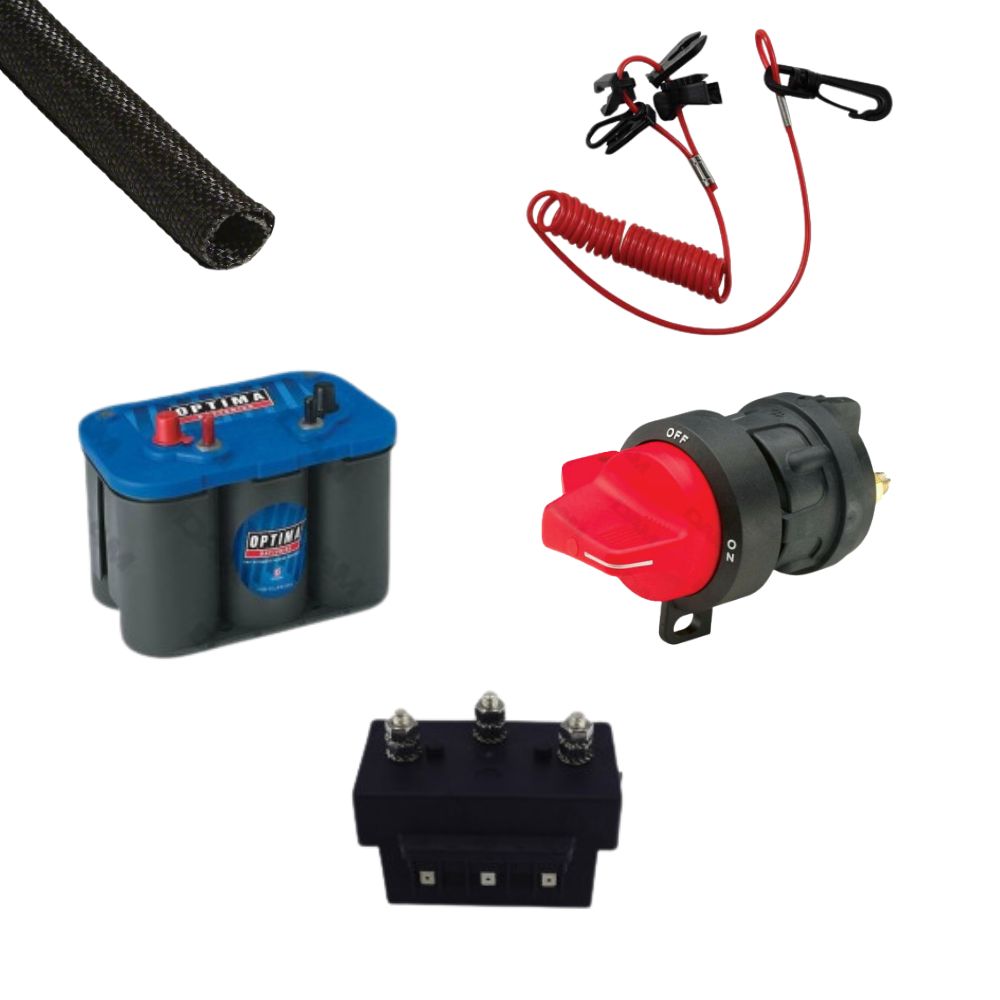
Circuit breakers and fuses protect circuits in case of overload or fault. Without them, an electrical anomaly can become dangerous, especially in a marine environment exposed to humidity, vibration and corrosion.
Why are charge controllers important?
The charge controller manages recharging to protect the batteries and stabilise the system. It prevents a charging source from operating irregularly or inappropriately.
As soon as you add a solar panel, another production source or a more advanced architecture, the controller becomes a key component of energy management.
What are chargers, converters and inverters used for?
The battery charger correctly recharges the bank when the boat is connected to shore power or another compatible source. The inverter converts direct current into alternating current to power certain 230 V devices.
These devices are useful, but they must remain coherent with the rest of the installation. Powering household appliances on board can quickly increase electrical needs.
Why monitor energy in real time?
A battery monitor helps you move beyond guesswork. It helps track voltage, current, remaining capacity and sometimes consumption history.
To go further, the guide on how to connect a boat battery monitor explains how to follow the condition of the battery bank more clearly.
This monitoring prevents you from discovering too late that a battery is low, that a device consumes more than expected or that a charging source is not providing what it should.
Why include isolation devices?
Battery switches, cut-off plates and suitable switches make it possible to quickly isolate part of the installation. This is useful for maintenance, diagnosis and safety.
While sailing or in port, being able to properly switch off a circuit reduces risks and simplifies interventions.
Which equipment consumes the most electricity on board?
The equipment that consumes the most on board is not always the one with the most impressive power rating. Some draw little but for a long time, others consume a lot occasionally, and repeated uses are often what weigh most in the energy balance.
Which consumption areas come up most often?
On many boats, the main areas are the refrigerator, lighting, navigation electronics, water pump, device charging, screens, on-board internet and sometimes comfort equipment.
Individually, some equipment seems modest. But over a full day, then over several days, their accumulation represents a real amount of energy.
Which devices mainly create high current draws?
Other equipment does not run for long, but requires a high current at start-up or over a short period. This is the case for the windlass, some thrusters, a heavily used inverter or an automatic pump.
A bilge pump, for example, should not be judged only by its average consumption: it must be correctly powered and protected, because its role is directly linked to boat safety.
This logic also ties in with general safety: some essential equipment depends on a reliable power supply. The guide to mandatory safety equipment helps place these needs within the boat’s overall safety inventory.
Does on-board internet change the energy balance?
Yes, especially if the installation remains active continuously. Router, antenna, tablet, computer or connected devices add comfort consumption that did not always exist on older installations.
Before equipping the boat, it is better to include this need in the overall balance. The guide to internet connection on board a boat helps put these uses into perspective.
How can you reduce consumption and gain autonomy?
Reducing consumption on board first means eliminating unnecessary losses and adapting usage. Once the installation is properly designed, the simplest gains often come from daily behaviour: lighting, refrigeration, screens, plugged-in devices and regular monitoring.
Why is switching to LED almost always useful?
LED lighting very significantly reduces consumption while often improving comfort of use. On a boat, where every ampere counts, this change is one of the most obvious optimisations.
It is particularly worthwhile because lighting is used every day, sometimes for long periods at anchor or during night navigation.
Which habits really save energy?
The right habits are simple: avoid leaving screens on unnecessarily, limit devices permanently plugged in, control the refrigerator temperature, switch off unused circuits and regularly monitor the batteries’ condition.
These actions may seem modest, but they change a lot over several days. Electrical autonomy is not only a matter of equipment: it is also a matter of method.
What should be done during lay-up or the low season?
During lay-up, energy management is directly linked to boat winterising. A poorly monitored battery over several months can lose performance, age prematurely or create unpleasant surprises when the season starts again.
When you dewinterize your boat, it is therefore useful to repeat the charge, connection and consumer checks before the first trips.
Checking the charge, disconnecting parasitic consumers and protecting the battery bank helps avoid many problems when returning to service.
What mistakes should be avoided to manage energy properly on board?
The main mistake is trying to correct a lack of autonomy only by adding battery capacity, without reviewing production, distribution or consumption. A larger battery does not solve insufficient charging, unsuitable wiring or an energy-hungry device.
You should also avoid confusing an electrical symptom with an engine fault. Insufficient charging, a tired battery or an ageing alternator can result in difficult starting, cut-outs or irregular behaviour. In this case, the guides on a boat engine that will not start, a boat engine that stalls or engine power loss can help broaden the diagnosis.
If alerts appear on the dashboard, the guide to understanding your boat warning lights can also help interpret signals linked to charging, the engine or the electrical installation.
Finally, emergency equipment should not be overlooked. A battery booster can help in certain situations, but it should not hide a lasting charging, battery or electrical circuit problem.
Start by checking the batteries, protections, connections and system coherence before adding new equipment.
Which DAM Marine equipment should you consider to make your installation more reliable?
To make on-board energy reliable, the most logical approach is to start with the structural elements: suitable battery, correct charging, clean distribution, readable protections and monitoring. Additional equipment then comes according to the navigation programme.
You can explore the boat electricity category, compare marine batteries, check alternators, complete the installation with charge controllers or secure the circuits with circuit breakers.
For concrete examples, a boater who wants to make engine charging more reliable can look at a 12V 55A alternator. Someone who wants to manage shore charging better can consider a YPower 12V 25A battery charger. For cleaner distribution, a compact electrical panel can already structure the installation.
What should you remember before checking your on-board electrical installation?
The right order of thinking is always the same: assess needs, produce enough, store correctly, distribute cleanly, protect each circuit and monitor consumption. This table summarises the priority points for managing energy on board a boat without unnecessarily complicating the installation.
| Step | Goal | Equipment or actions | Why it is a priority |
|---|---|---|---|
| 1. Produce | Ensure a regular source of electricity | Alternator, solar, wind turbine, hydrogenerator, shore charger, generator set | Without sufficient production, batteries always end up dropping too low. |
| 2. Store | Keep available energy | Engine battery, service battery, AGM, gel or lithium | Storage determines autonomy and starting safety. |
| 3. Distribute | Power the circuits cleanly | Electrical panel, suitable wiring, battery switches | Clear distribution makes use, maintenance and diagnosis easier. |
| 4. Protect | Limit electrical risks | Fuses, circuit breakers, suitable protections, clean connections | An electrical fault can become dangerous in a marine environment. |
| 5. Monitor | Understand real consumption | Battery monitor, voltage check, usage tracking | Monitoring prevents unpleasant surprises and approximate diagnoses. |
| 6. Save | Extend autonomy | LED, cold management, unused circuits switched off, reasoned usage | Repeated savings count as much as the equipment installed. |
FAQ: what questions should you ask about energy on board a boat?
Can you keep a simple installation without switching to lithium?
Yes. On a lightly equipped boat or one used occasionally, a well-designed AGM or gel installation can remain perfectly suitable. Lithium becomes especially relevant when you are looking for more usable capacity, less weight and faster charging.
Is a generator set essential to be autonomous on board?
No. It becomes particularly relevant on very well-equipped boats or for uses requiring a lot of power. For many boaters, a healthy alternator, coherent batteries, a suitable charger and solar panels are already enough to noticeably improve autonomy.
Why does my battery discharge even when I use almost nothing?
A battery can discharge because of invisible consumers, a device left on standby, insufficient charging, an ageing battery or a current leak. Permanent consumers, the condition of the connections and the real capacity of the battery bank must be checked.
Should the engine battery and service battery be separated?
Yes, it is strongly recommended. The engine battery must remain available for starting, while the service battery powers on-board equipment. This separation limits the risk of ending up with an engine that cannot be started after a night at anchor.
How do you know if the installation produces enough electricity?
You need to compare daily consumption with the real production of the charging sources. A battery monitor, voltage check and monitoring of the devices used make it possible to know whether the production-consumption balance is coherent.
Start with the batteries, protections, chargers and accessories suited to your boat.