


 Catalog
 Exploded views
















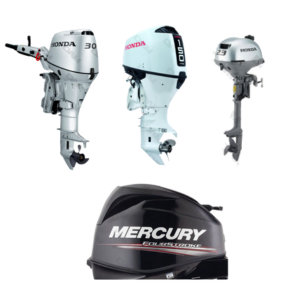
 Honda Marine









 Parts views
 Technical documents
 Ask for a quote
 Return request
DAM Marine helps you compare the reference, power, rotation, transmission and peripherals before purchase.
The price of an inboard engine can range from a few thousand euros for a reconditioned block to more than €20,000 for a complete engine pack. The real challenge is not only comparing prices: you also need to understand what is included, what will need to be reused on your boat and what may require fitting adaptations.
The price of an inboard engine is directly linked to the type of product: bare block, bobtail, engine pack or complete engine with peripherals. A new inboard engine is generally more expensive, but it provides a mechanical base with no usage history. A reconditioned engine can often reduce the budget, provided you carefully check the references, rotation, transmission and components to be reused. Installation must be anticipated from the start, because access to the engine compartment, the gearbox, cooling, exhaust and tests can strongly affect the final cost.
What is the price of an inboard engine in 2026?
The price of an inboard engine usually falls within a wide range, because a simple engine block is not the same purchase as a complete pack ready to replace an existing power unit. To compare two offers properly, you need to look at the engine type, power, fuel, engine condition, included peripherals and installation constraints.
An inboard engine is installed inside the hull of the boat, unlike an outboard engine mounted on the transom. This architecture makes replacement more technical: space, shaft, gearbox, exhaust, cooling circuit and mounts must all be consistent with the boat. To better understand this choice of motorisation, you can also read the DAM Marine guide on choosing between an inboard engine and an outboard engine.
Is the engine sold complete?
An engine pack or bobtail costs more than a bare block, but it can reduce the number of parts to recover from the old engine. It is often simpler for a clean replacement.
Does power change the budget?
Yes. The higher the displacement, power and equipment level, the more the engine, peripherals and sometimes the transmission cost.
Can the boat require adaptations?
Yes. Tight engine access, a specific shaft line, an old exhaust system or a different gearbox can increase installation cost.
What inboard engine prices can you find at DAM Marine?
The examples below give concrete reference points for different inboard engines, new engine blocks and reconditioned blocks available in the DAM Marine environment. Prices should always be checked on the product pages, as availability, configuration or price may change.
| Product | Type | Fuel | Power / displacement | Indicative price incl. VAT |
|---|---|---|---|---|
| Quicksilver 3L bobtail engine pack (8M0116646) | Pack / bobtail | Gasoline | 3.0L · 4 cyl. | 11 430,28 € |
| Quicksilver 5.7 MPI 300HP Alpha engine pack (8M0136293) | Pack / bobtail | Gasoline | 5.7L · 300HP | 19 254,34 € |
| Quicksilver 5.7 MPI 300HP Bravo engine pack (8M0136294) | Pack / bobtail | Gasoline | 5.7L · 300HP | 19 843,33 € |
| Reconditioned Mercruiser 383 MPI 350HP Bravo engine pack (865108R80) | Pack / reconditioned | Gasoline | 383 · 350HP | 20 113,14 € |
| Reconditioned GM262 plastic VR block (ESR262VP) | Reconditioned block | Gasoline | V6 · 4.3L | 5 056,75 € |
| New GM 3L Quicksilver engine block (BK181) | New block | Gasoline | 3.0L · 4 cyl. | 8 691,16 € |
| New GM V8 5L Vortec engine block (BK305I) | New block | Gasoline | V8 · 5.0L | 9 540,00 € |
| New Quicksilver GM V8 5.7L engine block (BK350N) | New block | Gasoline | V8 · 5.7L | 11 507,98 € |
| New Quicksilver GM V8 6.2L engine block (BK377) | New block | Gasoline | V8 · 6.2L | 14 812,32 € |
| Reconditioned GM454 GIV RH block (ESR454D) | Reconditioned block | Gasoline | V8 · 7.4L | 11 940,00 € |
The same selection can also be viewed as product cards, with the product images used in the original page.
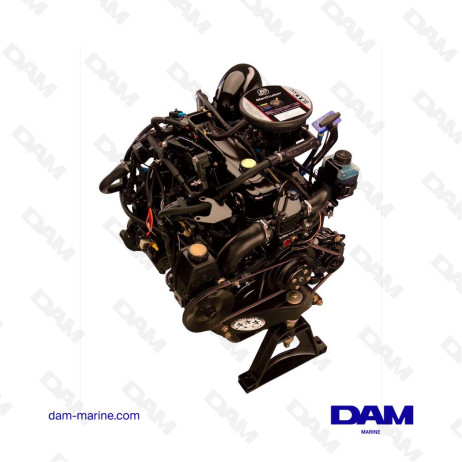
Quicksilver 3L 4-cylinder new bobtail engine pack
DAM ref.: 8M0116646
€11,430.28 incl. VAT
View product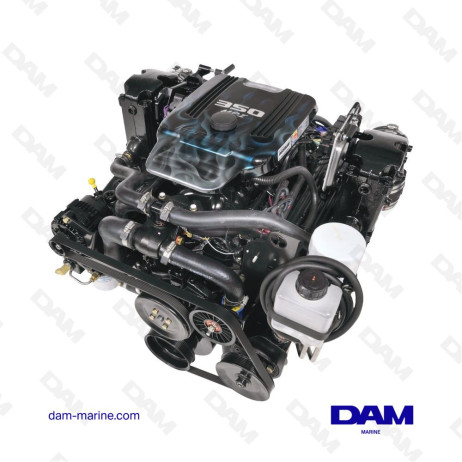
Quicksilver 5.7 bobtail MPI 300HP Alpha new engine pack
DAM ref.: 8M0136293
€19,254.34 incl. VAT
View product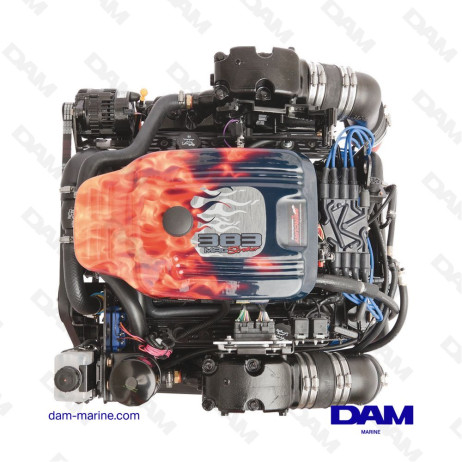
Reconditioned Mercruiser 383 bobtail MPI 350HP Bravo engine pack
DAM ref.: 865108R80
€20,113.14 incl. VAT
View product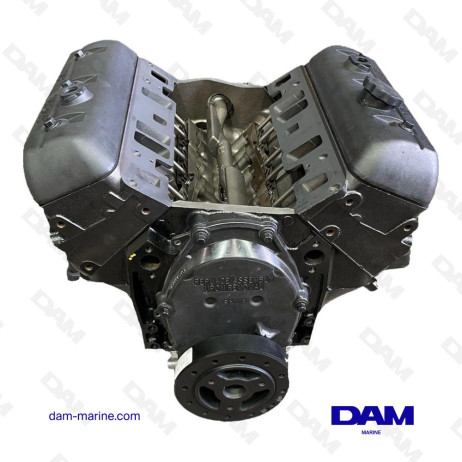
To broaden the comparison, you can also browse engine packs, engine blocks or reconditioned engine blocks.
Why does a new inboard engine cost more?
A new inboard engine costs more because it provides a mechanical base with no prior wear, recent components and often a more complete configuration than a simple replacement block. This higher price can make sense when the boat deserves a long-term investment or when the old engine has too many uncertainties.
New equipment avoids starting again with an unknown history. However, it is still essential to check that the power, engine base, injection, cooling circuit and transmission really match the boat. To frame this decision before buying, the guide to choosing a boat engine helps you ask the right questions.
Does buying new limit bad surprises?
It mainly reduces risks linked to internal wear, unknown previous repairs and tired parts. Compatibility still has to be checked.
Does the price include all peripherals?
Not always. Alternator, starter, manifolds, heat exchanger, injection, gearbox or wiring harness may or may not be included depending on the product.
Can a new engine increase the boat’s value?
It can reassure a future buyer, especially if the installation is documented. But the budget must remain consistent with the age and overall value of the boat.
Is a diesel inboard engine always more expensive?
A diesel inboard engine is often more expensive to buy than a comparable gasoline engine, but it can be worthwhile on a heavy boat, sailboat, cruising motorboat or for regular use at steady rpm. The final cost depends heavily on power, gearbox, cooling, exhaust and accessibility.
Marine diesel is valued for its torque and efficiency, but it requires rigorous maintenance. Before replacing a diesel engine, you should also check the diesel fuel circuit, filtration, heat exchanger and exhaust line. To understand the mechanical basics, DAM Marine offers a guide to how a diesel boat engine works.
Is diesel suitable for every boat?
No. It is mainly suited to boats that need torque, range and endurance. On some smaller boats, gasoline can remain simpler.
Why does the gearbox matter so much?
The gearbox transmits power to the shaft line. Incompatibility can require costly adaptations or an additional replacement.
Can cooling change the quote?
Yes. A tired heat exchanger, worn seawater pump or scaled circuit can turn a simple replacement into a larger job.
What is the price of a reconditioned inboard engine?
The price of a reconditioned inboard engine is generally lower than that of an equivalent new assembly, but it varies according to the level of rebuilding, replaced parts and components supplied with the block. It is a relevant solution when the aim is to restart with a checked mechanical base without buying an entirely new engine.
A reconditioned block can be worthwhile if your current peripherals can still be used. However, if the old engine has suffered overheating, major corrosion or lubrication failure, you need to check what can actually be reused. The diagnosis then overlaps with the questions covered in the guide to boat engine repair.
Reconditioned block or reconditioned pack?
The reconditioned block mainly concerns the mechanical base. A reconditioned pack can include more components, which often explains a higher price.
Which components should be checked?
Check the manifolds, heat exchanger, intake, injection, starter, alternator, mounts and connections.
Is reconditioned always profitable?
It is profitable if compatibility is good and the peripherals do not trigger a cascade of additional costs.
First compare the engine reference, reusable components and installation cost before choosing based only on the displayed price.
Should you buy a used inboard engine?
A used inboard engine can look attractive, but it must be purchased with caution, because a low price can hide internal wear, advanced corrosion or tired peripherals. This option can work if the history is clear, compression is good and compatibility with your boat is confirmed.
Before buying, ask for as many details as possible: engine hours, invoices, origin, storage conditions, detailed photos, running video and exact reference. An engine that already shows symptoms such as power loss, abnormal smoke or unstable idle can quickly cost more than expected.
Which warning signs should you watch for?
Persistent smoke, milky oil, corrosion around the manifolds, difficult starting, marked vibration or unstable temperature should call for caution.
Should you listen to the engine running?
Yes, ideally cold and then hot. A test helps detect difficult starting, mechanical noise, smoke or rising temperature.
Is compatibility the priority?
Yes. A poorly compatible used engine can require more adaptations than a better chosen engine that costs more at the start.
If the used engine already shows a specific symptom, it is useful to compare with the DAM Marine guides on a boat engine that will not start, boat engine that stalls, engine overheating, loss of power, engine vibration or smoking boat engine.
How much does it cost to install an inboard engine?
The cost of installing an inboard engine depends on removal time, access to the engine compartment, mechanical adaptations and the tests required after installation. You should not reason only with the engine price: labour, consumables, peripheral parts and commissioning must be included in the budget.
A clean installation generally includes removing the old engine, preparing the engine bay, checking mounts, connecting fuel, cooling, exhaust, electrical system and transmission, then functional checks. This topic also links to the overall operation of a boat’s propulsion system.
Is removal always simple?
No. Some engine compartments require removing interior fittings or using suitable lifting equipment.
Which circuits need to be renewed?
Fuel, cooling, exhaust, wiring harness, controls, engine mounts and transmission must be checked together.
Are tests essential?
Yes. Tests validate temperature, rpm, vibrations, leaks, electrical charging and behaviour underway.
When should you repair or replace your boat engine?
Replacement should be considered when the repair cost approaches a significant share of the engine’s value or when several major components are affected at the same time. Conversely, an isolated, clearly identified and accessible fault can often justify a targeted repair.
The decision depends on the engine’s internal condition, parts availability, age, boat usage and risk of further failures. Severe overheating, internal corrosion, mechanical breakage or significant compression loss can make replacement more rational than a series of repairs.
Good reflex: before replacing an engine, check the external causes that may have damaged it. A problem with the fuel circuit, cooling circuit or exhaust can damage a new engine if the cause is not corrected.
How do you choose the right inboard engine reference?
The right inboard engine reference is chosen by cross-checking the brand, model, displacement, power, year, engine base, rotation, transmission and equipment already present on the boat. A close reference is not always enough: two visually similar engines can have different peripherals or mounting configurations.
The serial number remains one of the best starting points. It helps identify the engine more precisely and avoid compatibility mistakes. To know where to find it, DAM Marine explains the method in its guide to finding a boat engine serial number.
Why is rotation important?
Rotation must match the transmission and propeller. A mistake can prevent proper fitting or change the boat’s behaviour.
Should you keep the same power?
The safest option is often to stay close to the original setup. More power can require checks on transmission, cooling and structure.
Should the propeller be checked?
Yes. Engine choice influences rpm and load. A poorly matched propeller can reduce performance and increase consumption.
After an engine change, it can be useful to review how a boat propeller works, especially if the boat does not reach the expected rpm or if thrust seems abnormal.
How can you control the total cost after purchase?
The total cost of an inboard engine is controlled by planning maintenance from the moment of purchase: filtration, cooling, lubrication, anodes, belt checks, winterizing and recommissioning. A well-chosen but poorly maintained engine can quickly become costly, especially in a marine environment.
To limit expenses, watch for weak symptoms: rising temperature, unusual smoke, unstable idle, long starting, vibration or rpm drop. Early intervention often costs less than an advanced failure.
Does seasonal maintenance really change the budget?
Yes. Proper winterizing limits corrosion, deposits, fuel problems and unpleasant surprises when launching again.
Should fuel consumption be monitored?
Yes. Higher consumption can reveal a mismatched propeller, dirty engine, fouled hull or poor trim/use settings.
Can fuel create failures?
Yes. Water in the fuel, clogged filter, air leak or tired hose can cause stalling, power loss or difficult starting.
On this point, the DAM Marine guides on boat winterizing, de-winterizing, using less fuel and fuel circuit problems help anticipate the most common maintenance items.
Which table should you keep in mind before asking for a quote?
Before asking for a quote, the most useful step is to compare the displayed price with the level of engine completeness, the parts to be reused and the complexity of installation. This table summarises the possible choices to better frame your budget.
| Solution | Main benefit | Point to watch | To include in the budget |
|---|---|---|---|
| New inboard engine | New mechanical base, clear history, durable solution | Higher purchase price and compatibility to validate | Engine, accessories not included, installation, fluids, tests |
| Reconditioned engine | Often a lower budget than a complete new unit | Exact level of reconditioning and supplied peripherals | Block or pack, parts to reuse, checks, fitting |
| Used engine | Potentially lower entry price | History, corrosion, compression, real operation | Purchase, diagnosis, safety parts, installation, contingencies |
| Repairing the existing engine | Relevant solution if the fault is isolated | Risk of successive expenses on an old engine | Diagnosis, parts, labour, post-repair tests |
Send the useful information to confirm compatibility before ordering an engine or a block.
Additional FAQ about inboard engine prices
Is an engine block enough to replace a complete inboard engine?
Not necessarily. An engine block mainly corresponds to the mechanical base. You must check whether the old engine peripherals can be reused: intake, exhaust, cooling, alternator, starter, mounts, wiring harness and controls.
Can you install a more powerful engine than the original one?
It is possible in some cases, but it is not simply a comfort choice. The hull, transmission, propeller, cooling, exhaust and insurance must be compatible with the new power.
Why do two engines with the same displacement not have the same price?
Price depends on the brand, equipment level, injection, availability, transmission configuration and engine condition. Two V8 engines with similar displacement can therefore have very different budgets.
Can installation cost exceed the cost of ancillary parts?
Yes, especially if access is difficult or if replacement requires adaptations. Labour can include removal, handling, connections, adjustments, consumables and tests.
Which documents should you prepare before asking for an engine quote?
Prepare the serial number, brand, model, year, power, photos of the engine plate, engine bay, transmission, manifolds and connections. These elements greatly speed up verification.
Is a gasoline inboard engine simpler to replace than a diesel?
Not always, but gasoline engines based on marinised GM blocks can sometimes offer more matches on certain configurations. Diesel often requires particular attention to the gearbox, diesel fuel circuit and cooling.