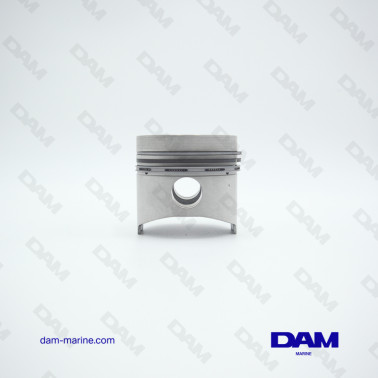
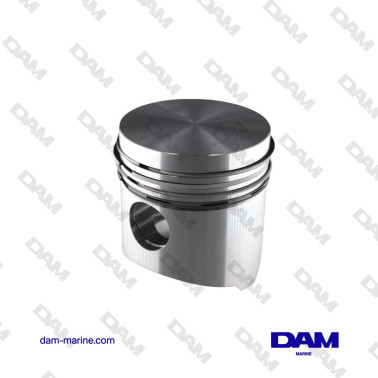
Which piston oversize should you choose?
The choice of size depends on the condition of the cylinder or liner. A precise measurement must be carried out in a workshop before any order, in order to check bore wear, ovality and taper.
- STD standard size: to be used when the bore is within manufacturer tolerances or when replacing a cylinder liner with a new one.
- +0.25 mm repair size: suitable after light reboring, when wear exceeds tolerances but remains limited.
- +0.50 mm repair size: used after more extensive reboring, generally following advanced wear, scoring or the beginning of seizure.
Important: older inch-based designations, such as +0.010" or +0.020", often correspond to repair sizes close to +0.25 mm and +0.50 mm. Always check the exact equivalence specified by the part manufacturer.
When should you replace a piston or piston rings?
Replacing a piston or piston rings is generally done during an engine rebuild, after a precise mechanical diagnosis. The most common symptoms are:
- Blue smoke from the exhaust: oil is entering the combustion chamber, often because of worn or stuck piston rings.
- High oil consumption: a worn piston, ring set or liner no longer ensures proper sealing.
- Loss of compression: values below the workshop manual specifications indicate internal wear that needs checking.
- Difficult starting: insufficient compression can make cold starting difficult, especially on a marine diesel engine.
- Persistent black smoke: if the injection system is correct, poor compression can cause incomplete combustion.
- Scoring, seizure marks or heat marks: a marked piston or scored cylinder requires a complete bore inspection.
Which parts should be replaced at the same time?
When working on pistons, it is recommended to replace or check several related parts. A poorly prepared partial rebuild can significantly reduce engine life.
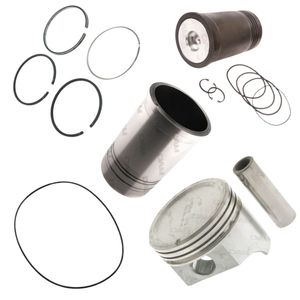
- Piston rings: always fit new rings with a new piston or during a cylinder rebuild.
- Piston pin and circlips: check or replace depending on condition, to avoid play and mechanical noise.
- Liner or cylinder: check the bore, ovality, scoring and surface condition before reassembly.
- Connecting rod bearings: check them when dismantling the moving assembly.
- Cylinder head gasket: always replace it after removing the cylinder head.
- Valves and seats: check them, as a burnt or poorly sealing valve can cause similar compression loss.
Common Yanmar references
The references below are given for guidance only. Compatibility must always be confirmed with the engine serial number, manufacturer documentation or the OEM reference of the original part.
| Engine series | Indicative OEM references | Possible sizes |
|---|
| 1GM / 1GM10 |
121000-22500 / 172100-22400 |
STD depending on version |
| 2GM20 / 2GM20F |
124200-22300 / 124200-22091 |
STD depending on version |
| 3GM30 / 3HM35 |
128370-22300 |
STD depending on version |
| JH series and other Yanmar engines |
To be confirmed by serial number |
STD / +0.25 / +0.50 depending on engine |
Ordering the right Yanmar Marine pistons
To avoid mistakes, note the exact engine model, its serial number, the current cylinder size and the OEM reference of the part removed. If the engine has already been rebored, never order a standard piston without prior measurement.
We offer pistons, rings, pins, gaskets, liners and internal parts for Yanmar Marine engines. To confirm compatibility, contact us with your full engine information.
Find our selection of pistons and internal parts to restore compression, reliability and performance to your Yanmar Marine engine.



 Catalog
 Exploded views















 Honda Marine








 Parts views
 Technical documents
 Ask for a quote
 Return request