What are the symptoms of a faulty Mercruiser carburettor?
Signs of wear or incorrect adjustment on a marine carburettor are often clear, but they require methodical diagnosis to isolate the fault:
- Unstable idle or stalling at low rpm: this is the classic symptom of a blocked idle circuit. Idle jets and mixture screws are extremely sensitive to varnish left by fuel evaporation, especially after long winter storage without stabiliser. A parasitic air leak at the carburettor gasket face or throttle shaft can also lean out the mixture and cause chronic instability.
- Excessive fuel consumption and black exhaust smoke: a persistent smell of unburnt fuel and dark smoke reveal a mixture that is far too rich. Mechanically, this often points to a needle valve that no longer closes the constant-level bowl correctly, due to a worn seat or marked needle, or to a porous or fuel-soaked float that has become heavy. Fuel then overflows through the vents directly into the venturis, risking engine flooding or even cylinder washdown.
- Flat spots on acceleration, hesitation or backfire, Lean Sneeze: if the engine bogs when the throttle lever is pushed, the accelerator pump is often at fault, with a torn diaphragm or worn piston. Conversely, a backfire at the flame arrestor indicates a transient mixture that is much too lean, possibly caused by a restriction in the main circuit or a bowl level set too low.
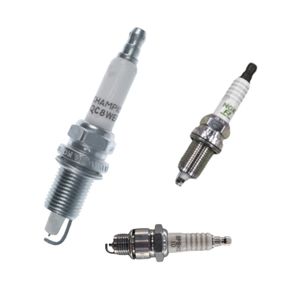
Before blaming the carburettor, also check ignition: worn spark plugs can imitate some carburation symptoms.
Identification criteria for replacement
Ordering the right carburettor for an inboard engine cannot be improvised. The first step is to locate the original OEM reference. Unlike automotive blocks, on Mercruiser carburettors, such as 2-barrel Mercarb or 4-barrel Rochester units, this reference is not always stamped on the casting: it is often found on a small coloured metal tag fixed by one of the bowl cover screws. Without this exact reference, the risk of calibration error is high.
You must then cross-check this information with your engine block architecture, L4 3.0L, V6 4.3L, V8 5.0L or 5.7L, and its production year. Watch out for changes: a 1989 V8 5.7L carburettor will not necessarily have the same main jets or accelerator pump settings as a 1997 model, even if the intake manifold bolt pattern appears identical.
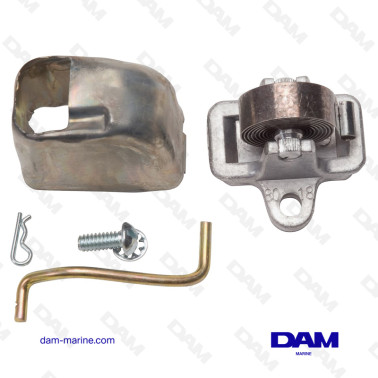
Finally, check the choke type. Is it a bimetallic electric choke or a mechanical model? The base diameter, fuel-line connection type, often reverse-threaded or marine-specific, and throttle linkage geometry are all points that must be formally validated before purchase.
Should you choose a rebuild or a full replacement?
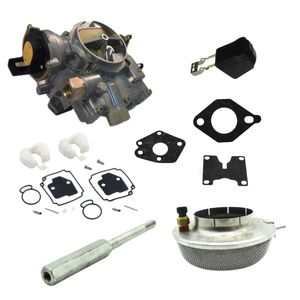
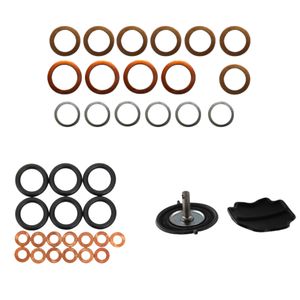
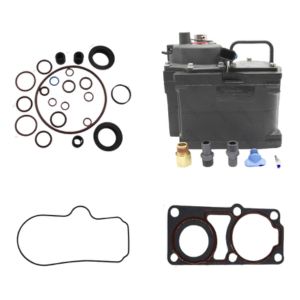
The Rebuild vs Replace question is common in workshops. Rebuild kits, including bowl gaskets, needle valve, seat, accelerator pump diaphragm and sometimes the float, are excellent for preventive maintenance or to correct fouling caused by prolonged immobilisation. Rebuilding does, however, require method, ideally ultrasonic cleaning of the alloy bodies, and good command of float height and float drop adjustment.
However, rebuilding reaches its limits when mechanical wear is present. If the engine has many running hours, the throttle shaft eventually wears its bore in the carburettor's aluminium base. This creates an air leak that cannot be sealed with simple gaskets, making idle adjustment ineffective.
Likewise, if the bowl shows deep corrosion marks, or pitting, caused by stagnant water and ethanol phase separation, the body cannot be recovered. In these cases, replacing it with a new carburettor is the only viable, reliable and lasting solution to restore original performance without chasing impossible adjustments.



 Catalog
 Exploded views
















 Honda Marine








 Parts views
 Technical documents
 Ask for a quote
 Return request